
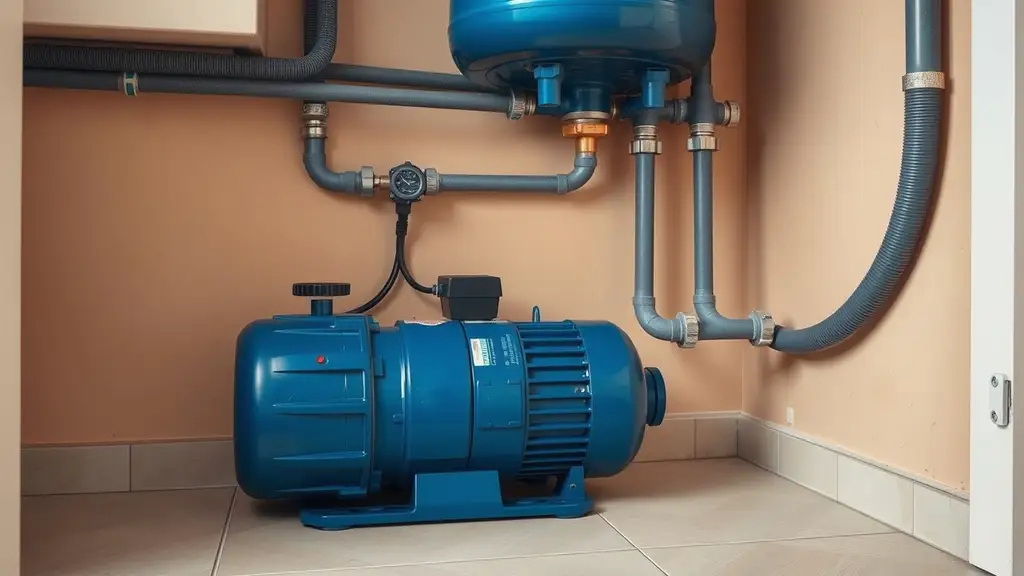
Booster pump calculator
A booster pump must keep pressure up when several outlets run together. Its required flow is the number of simultaneous outlets times the flow of each.
Your measurements
Result
- Flow the pump must deliver
- 24 L/min
- Equivalent
- 1.44 m³/h
Choose a pump whose flow at working pressure (usually 2.5–3.5 bar) is at least this value — not the maximum flow, which is given at zero pressure.
How the calculation works
- Flow needed (L/min) = outlets running at the same time × average flow per outlet.
Worked example
If 3 outlets can run at once (a shower, a sink and the washing machine) at 8 L/min each, the pump must deliver at least 24 L/min, about 1.44 m³/h.
What the calculator assumes
- An ordinary tap runs at 6–8 L/min, a shower at 8–12 L/min.
When to adjust the result
- Read the flow on the pump's data sheet at working pressure (usually 2.5–3.5 bar), not the maximum flow, which is given at zero pressure.
- For a well, the water depth and the well's yield matter too: a surface pump lifts from at most about 8 m; deeper, a submersible pump is used.
- A larger pressure vessel reduces pump starts and extends its life.
Avoiding the common pump mistakes
Size the pump on the flow you actually need at the pressure you need, read from the pump curve — not on the maximum flow printed on the box, which applies at zero pressure. Add the height difference to the highest tap and the pipe losses to the pressure you want there.
A pressure tank of 50–100 litres stops the pump starting for every glass of water. Set the tank's air pre-charge slightly below the pump's cut-in pressure, with the pump off and the system drained, and check it once a year. Dry-run protection is worth it if the source can run low.
Frequently asked questions
What flow rate does a house need?
Add the outlets that can run at once: three outlets at 8 L/min need about 24 L/min.
Why does the pump's maximum flow mislead?
It's measured at zero pressure; at the 2.5–3.5 bar a house needs, the real flow is lower.
Why does my pump keep switching on and off?
Usually the pressure tank has lost its air charge or its membrane has failed, or there is a leak somewhere in the system.
How much pressure do I need at the tap?
About 2–3 bar is comfortable for showers and appliances; much higher pressure wastes water and strains fittings, so a pressure-reducing valve may be needed.