
Updated · 4 min read
In short
- Every path needs a deliberate fall of about 1–2 cm per metre — invisible to the eye.
- Always drain away from the house foundations, never towards them.
- Test with a bucket of water on the levelled base before the final finish.
Why a completely flat path puddles anyway
Even if a path looks level, no surface poured or laid by hand is perfectly flat. Small imperfections — a slightly lower joint, a paver that settled a millimetre more than its neighbour, unevenly compacted sand — become low points over time where rainwater collects and stays. Without a deliberate fall, these low points appear randomly, not where you'd expect, often right in the middle of the path where people walk most.
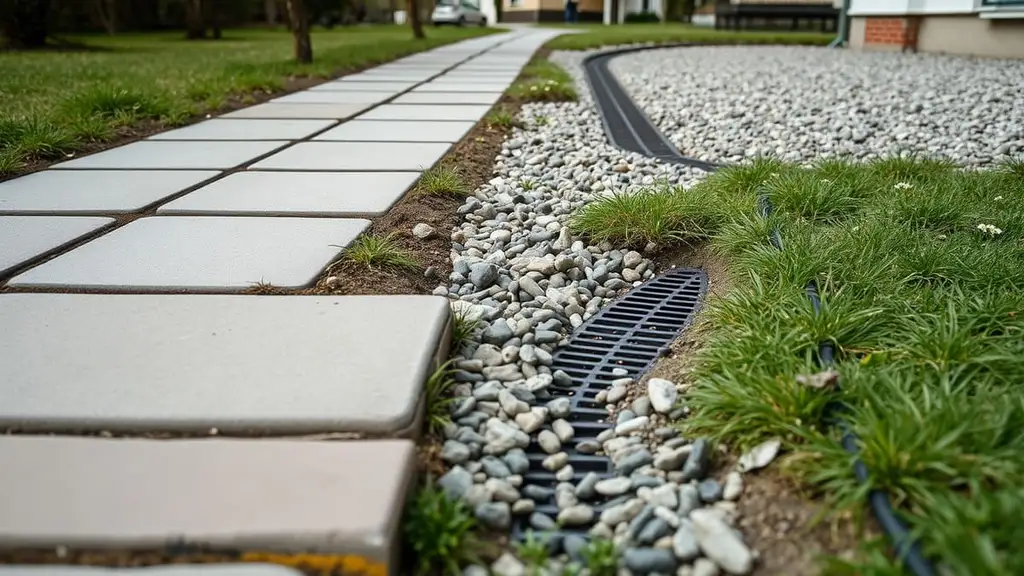
That's why any well-built path is poured or laid with a small, deliberate fall, even if it looks almost flat. A fall of 1–2 cm per metre isn't visible to the naked eye, but it's enough for water to drain steadily in a set direction — towards a soakaway area in the garden or a channel drain, never towards the house foundations. That last rule is absolute: any path close to a building must drain away from the wall, not towards it.
Cross-fall vs. longitudinal fall
A cross-fall, as a gentle camber from the centre of the path to both edges, works well on straight, wide paths without raised edges that would hold water at the sides — water runs off evenly on both sides onto the lawn or the surrounding gravel. It suits main paths over a metre wide, where a single fall in one direction would leave half the surface almost flat.
A longitudinal fall, along the route, is used on narrower paths or short sections where water has to be led to a single collection point — a channel drain at the end of the path, for example, or a low area of the garden designed to absorb water. In practice many paths combine both: a slight cross-fall across the width plus an overall longitudinal slope towards the lowest drainage point in the garden.
What happens when drainage is ignored
Standing water on a path isn't just unsightly. In winter, the same puddles become sheets of ice exactly where people walk every day — the gate, the entrance, the steps — and remain one of the most common causes of domestic accidents in winter. The rest of the year, water that doesn't drain seeps into the joints between pavers or slabs and reaches the base layer underneath.
There, repeated freeze–thaw cycles in the colder months make the trapped water expand as it freezes and push the paving up from below, year after year, until you get bumps, cracks and rocking pavers. Repairing a base damaged by repeated infiltration costs much more than a correct fall would have from the start — drainage problems rarely fix themselves; they get steadily worse.
Checking the fall in practice before finishing
The simplest check, with no special tools, is to pour a bucket of water on the path once the base is levelled but before the final surface, and watch where it collects. Any point where water stays for more than a few seconds marks a low spot that must be corrected in the sand or sub-base layer — not ignored in the hope the finish will make up for it. It won't.
Calculators for this job
Paving calculator
How many pavers a path, driveway or patio needs, with cutting waste included.
Gravel calculator
How many cubic metres and tonnes of gravel or hardcore a layer under a foundation, path or hardstanding needs.
Sand calculator
How many cubic metres and tonnes of sand a bedding layer under paving, a path or a light foundation needs.