
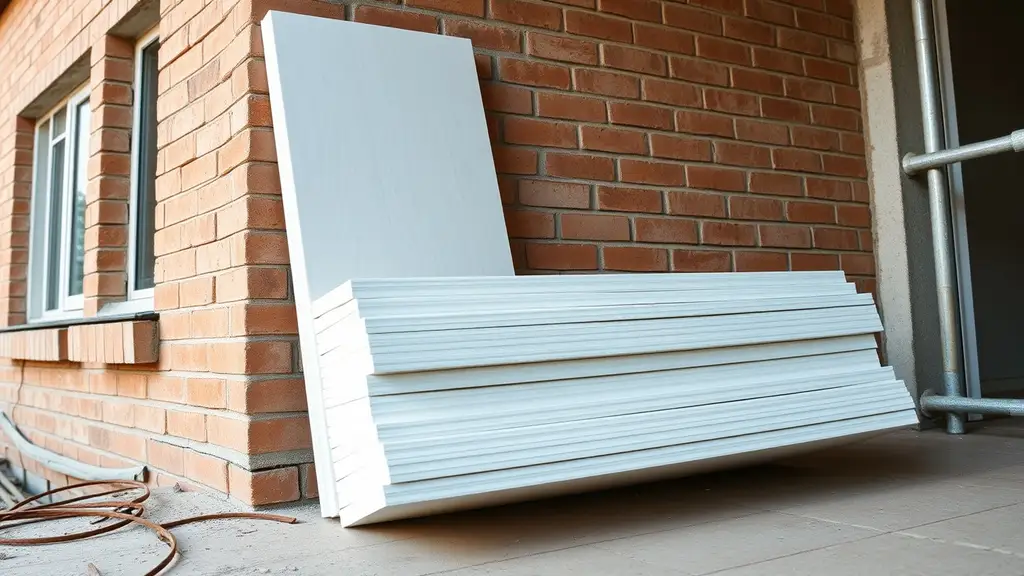
Insulation board calculator
Insulation boards come in fixed formats — 100 × 50 cm is the most common for façade EPS, while mineral wool slabs and XPS vary by manufacturer. This calculator turns the area to insulate into a board count and the volume of insulation, which is how many suppliers price it.
Enter the board format from the product sheet. The insulation thickness doesn't change the number of boards, but it does change the volume — and the thermal performance, which you can check with the U-value calculator.
Your measurements
Result
- Insulation volume
- 5.00 m³
- Boards to buy
- 105 pcs
The board count is the same for EPS, XPS and mineral wool slabs — only the format on the pack changes.
How the calculation works
- Volume (m³) = area × thickness (cm) ÷ 100.
- Board area = board length × board width (for example 1.0 × 0.5 m = 0.5 m²).
- Boards = area × (1 + waste %) ÷ board area, rounded up.
- Packs = boards ÷ boards per pack, rounded up (if you enter the pack size).
Worked example
For 50 m² of façade insulated with 10 cm boards, the volume is 50 × 10 ÷ 100 = 5 m³. With 100 × 50 cm boards and 5% waste you need 50 × 1.05 ÷ 0.5 = 105 boards.
What the calculator assumes
- 5% waste covers cuts around windows and corners; complex façades with many openings need more.
- The board count is the same for EPS, XPS and mineral wool — only the format differs.
When to adjust the result
- An external wall insulation system (ETICS) also needs adhesive, a reinforced base coat with mesh, fixings (dowels), edge and base profiles, primer and render — follow the system manufacturer's consumption figures.
- The plinth and anything below ground level are usually insulated with XPS or special plinth boards that don't absorb water.
- The right thickness depends on the existing wall and on local energy requirements; for an existing building, ask an energy adviser which value applies to you.
Frequently asked questions
How many EPS boards are in a cubic metre?
At 10 cm thickness, one cubic metre is 10 m² of boards — 20 boards of 100 × 50 cm. At 20 cm it's 5 m², or 10 boards. Divide 1 by the board volume (length × width × thickness in metres).
EPS or mineral wool for a façade?
EPS is lighter and usually cheaper; mineral wool is non-combustible, more vapour-open and better for sound insulation. Fire regulations for taller buildings may require mineral wool in some areas — check local rules.
Does a thicker board need more boards?
No. The number of boards depends only on the area and the board format. Thickness changes the volume, the weight and the thermal performance.