
Updated · 5 min read
In short
- Small holes are repaired the same way on both; large ones are not.
- On brick, fill large holes with mortar or a piece of block before the final coat; on plasterboard, fit a board patch.
- Knock on the wall: a dull, solid sound means masonry; a hollow sound means plasterboard.
Why the same hole isn't repaired the same way on every wall
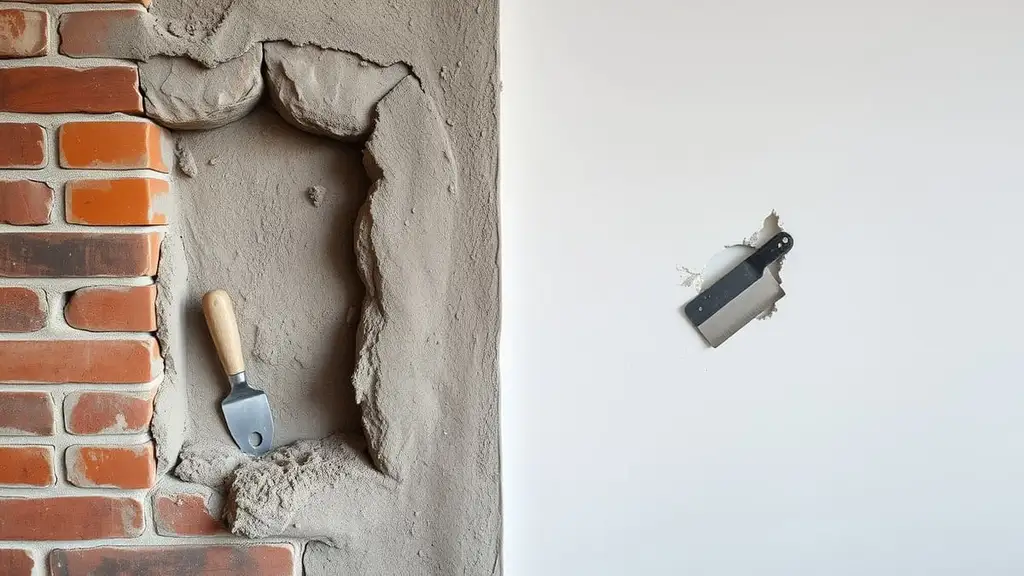
A hole of the same size can need a completely different approach depending on what's behind the plaster or the board. Brick or masonry walls are dense and strong, several centimetres thick, while plasterboard walls are a board a few millimetres thick on a metal or timber frame, with an air gap behind. The two behave completely differently when repaired, and the wrong method leads either to a fragile repair or to pointless work on a material that didn't need it.
The first practical step, before choosing any material, is simply identifying the wall type — quick, but surprisingly often skipped.
Brick or masonry walls
A small hole in a brick wall is repaired much like one in plasterboard — filler or skim coat applied with a filling knife, sanded and painted — because at that size only the surface finish matters, not the structure underneath. The difference shows with larger holes of a few centimetres or more: on brick, such a hole may need filling with mortar, or even a piece of brick or aerated block cut to size, before the final skim coat.
The reason is simple — the base material is far denser and stronger than plasterboard, and filling a large void with filler alone, without solid support beneath, leaves an area without the mechanical strength of the rest of the wall, even if the surface looks fine right after the repair.
Plasterboard walls
A plasterboard wall changes the rules completely. Behind the board there's an air gap, supported by a metal or timber frame at regular intervals — not solid material across the whole surface. So a large hole, over a few centimetres, can't simply be filled: material applied straight over the void has nothing to rest on and, over time, sags or cracks under its own weight.
For large holes in plasterboard the right solution is a patch cut from a new piece of board, fixed firmly and covered with joint tape and filler applied in thin successive coats — the procedure described step by step in the guide on invisible plasterboard patches.
Different resistance to future knocks
Beyond the technique, the two materials behave differently in the long term when hit again — an accidental knock, furniture being moved or something dropped against the wall. A repair in brick, finished with mortar or a solid piece of material, tends to be as strong as the original wall, because the base underneath stays dense and continuous.
A repair in plasterboard remains structurally a potentially weaker area if it isn't properly supported — for example without a new piece of board fixed to the frame, just a thick layer of filler over an unfilled gap. So on plasterboard, the mechanical support of the patch matters as much as the visible finish.
How to tell the wall type quickly before choosing a method
The simplest test, with no special tools, is the sound when you knock lightly with your knuckle in a few places around the hole. A full, dull sound means solid masonry — brick or concrete, continuous with no air gap. A hollow sound means plasterboard, with air between the board and the structural wall behind.
This quick test, done before buying any material, avoids the wrong approach from the start — for example cutting a plasterboard patch for a brick wall, or trying to fill a hole in thin board with mortar, which simply isn't thick enough for it.
Calculators for this job
Wall filler calculator
An estimate of the filler needed for holes and cracks in a wall.
Plasterboard calculator
How many plasterboard sheets a wall or ceiling needs, depending on the board size and waste.
Mortar calculator
How many kilograms and bags of mortar or adhesive a brick or aerated-concrete wall needs, depending on the wall thickness.