
Updated · 4 min read
In short
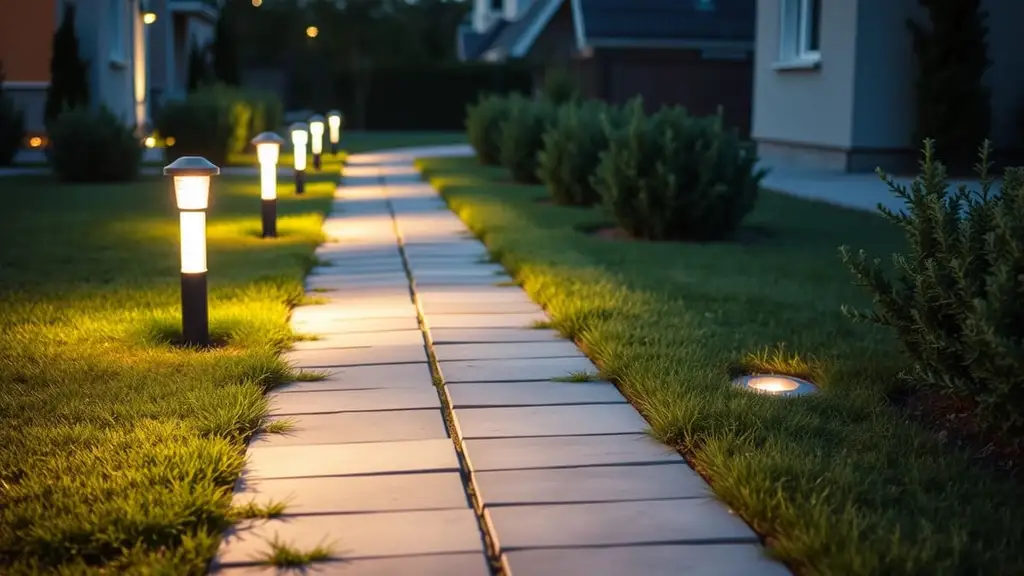
- Low ground spots every 2–3 m, bollards every 4–5 m, so no stretch is completely dark.
- Too many lights flatten contrast and make steps harder to see.
- Light corners, steps and changes of level first.
The double role of path lighting
Path lighting really has two separate jobs, even when the same fixtures do both. The first is safety walking at night — seeing the edges of the path, steps, uneven spots and changes of level so nobody trips or steps off the path. The second is general orientation in the garden: lights that mark the route from the gate to the door and help someone who doesn't know the garden find the way without guessing.
The two jobs need different light: safety lighting should be low and aimed at the ground, so it doesn't dazzle and picks out exactly the uneven spots, while orientation lighting can be a little higher and more diffuse, enough to outline the route from a distance.
Spacing between lights
The practical rule is that there should be no completely dark stretches between two consecutive lights — which doesn't mean multiplying fixtures at every step. For low spots mounted at ground level along the path, 2–3 m between them usually gives continuous coverage without blind spots or pointless overlap. For taller bollards the spacing can rise to 4–5 m, depending on the output and beam angle of each fixture.
Too many lights placed too close together have the opposite effect — excess light flattens contrast and, paradoxically, makes it harder to see the real relief of the path, the steps or the edges. Sparser lighting placed exactly at the critical points (corners, changes of level, junctions) is better than dense, even lighting along the whole length.
Fixtures that suit paths
Low spots, recessed at ground level or mounted at the edge, are the most effective for walking safety, because the light falls straight on the surface you walk on. Bollards placed at regular intervals along the route also give visual orientation from a distance, useful on long or curving paths. Motion sensors suit access points — the gate, the main entrance — where the light comes on only when needed instead of staying on all night.
Solar lights need no cabling, so they are the simplest to install, especially on a finished path you don't want to dig up again for cables. The trade-off is lower brightness than mains-powered fittings and dependence on daytime sun — in a spot heavily shaded by trees or fences, solar lights can have reduced brightness and running time on cloudy days or in winter, when days are short.
Placement at corners and changes of level
Regardless of the rest of the route, the points that deserve absolute priority are corners with poor visibility, deliberate steps or slopes (for example where the path follows the fall of the ground) and transitions between different materials, where a difference in level or texture is easy to miss in the dark. A single well-placed spot right at a step does more for safety than ten fixtures along a flat, straight stretch.
Calculators for this job
Garden lighting calculator
How many outdoor lights and how much cable a garden path needs, from its length and the light spacing.
Paving calculator
How many pavers a path, driveway or patio needs, with cutting waste included.
Electrical cable calculator
An estimate of the electrical cable a home's sockets and lights need.