
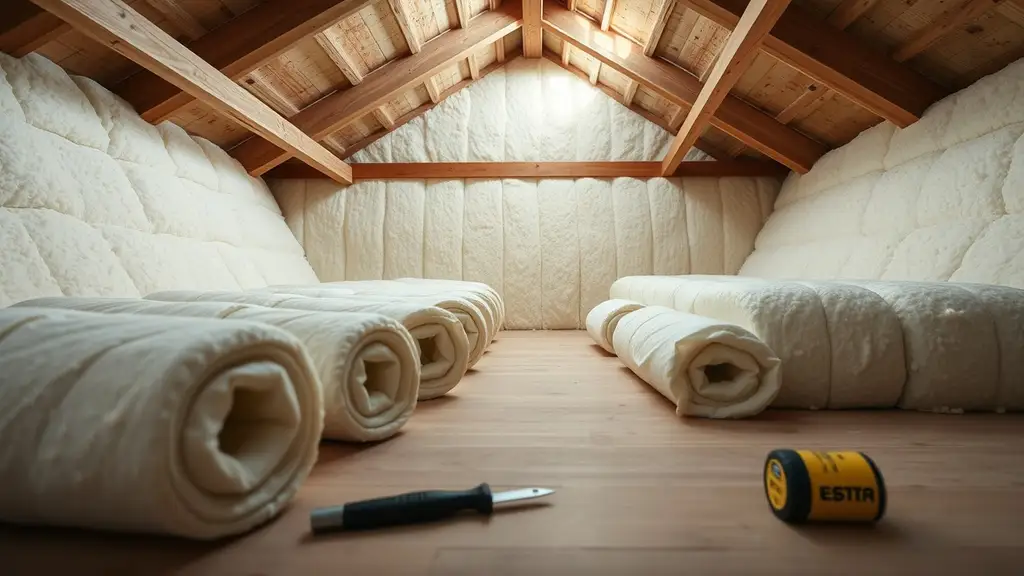
Mineral wool calculator
Mineral wool is sold in packs of slabs or in rolls, and the area in each pack depends on the thickness. Enter the area, the thickness and the coverage printed on the pack.
Your measurements
Result
- Volume of insulation
- 5.00 m³
- Packs / rolls needed
- 42 pcs
The area per pack depends on the thickness — read it on the label for the thickness you buy. No waste is added: allow 5%.
How the calculation works
- Volume (m³) = area × thickness (cm) ÷ 100.
- Packs = area ÷ area covered by one pack at that thickness, rounded up.
Worked example
For 50 m² insulated with 10 cm of wool the volume is 50 × 10 ÷ 100 = 5 m³. If a pack of slabs covers 1.2 m², you need 50 ÷ 1.2 = 41.7, so 42 packs.
What the calculator assumes
- The area per pack falls as the thickness grows: the same pack holds fewer thick slabs than thin ones. Stone wool slabs come in small packs; glass wool in rolls of 5–9 m².
- No waste is added; for cuts around rafters or studs, add 5%.
When to adjust the result
- Lofts usually get 20–30 cm in two layers laid crosswise, so no joints run through.
- On the warm side of insulation in a loft conversion, fit a vapour control layer with taped joints — otherwise the wool gets damp.
- Façades use dense façade-grade stone wool, not loft insulation.
Installing mineral wool without gaps
Insulation only works if it fills the space completely. Cut rolls and slabs about 1 cm wider than the gap between rafters or studs so they stay in by friction, butt joints tightly and stagger layers so joints do not line up.
In heated rooms, a vapour control layer on the warm side, taped at every joint and penetration, stops moist indoor air from condensing inside the insulation. Keep a ventilation gap above insulation where the roof build-up needs it, and wear gloves, long sleeves and a dust mask when cutting.
Frequently asked questions
How thick should loft insulation be?
Commonly 20–30 cm of mineral wool, laid in two layers. The required thermal performance depends on local building regulations.
Glass wool or stone wool?
Glass wool is lighter and cheaper for lofts and stud walls; stone wool is denser, better for façades, fire protection and sound insulation.
Glass wool or stone wool?
Glass wool is lighter and cheaper; stone wool is denser, better for sound and fire and keeps its shape in walls and floors.
Does compressed insulation still work?
Less well — squeezing mineral wool reduces its thickness and therefore its insulating value.