
Updated · 5 min read
In short
- Plan general, mirror (task) and optional accent lighting separately.
- Light the mirror from both sides at face height, not from a single spot above.
- Check the IP rating for each position — the closer to the bath or shower, the higher it must be.
The three lighting zones of a bathroom
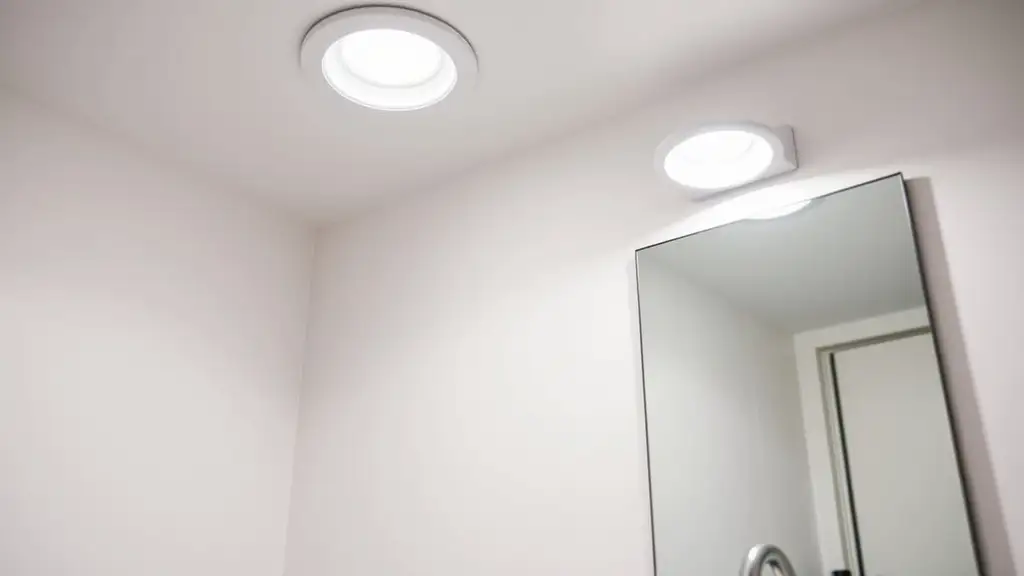
A well-lit bathroom isn't one central bulb. There are really three different lighting needs, and treating them separately transforms everyday comfort. General (ceiling) lighting gives basic visibility for moving around and cleaning — usually a spot or a central fitting bright enough for the room, but rarely enough for tasks that need precision.
Task lighting around the mirror covers the daily routine — shaving, make-up, skincare — where precision matters. Accent lighting is optional and purely decorative: an LED strip under the basin, in the shower niche or behind the mirror, adding atmosphere without contributing much to functional visibility. Many bathrooms have only the first zone, which explains the common feeling of 'not enough light' at the mirror even when the rest of the room seems bright.
Lighting around the mirror: correct positioning
The most common mistake is a single spot above the mirror, which casts strong shadows under the eyes, nose and chin — exactly where you need clear visibility for shaving or make-up. Side lighting, with sources on both sides of the mirror at face height, lights the face evenly without hard shadows. If there's no room for side lights, an LED strip around the mirror or a back-lit mirror panel are effective alternatives.
Brightness matters as much as position — a weak source, even well placed, still forces you to lean in to see details. Check the light output (lumens) recommended for the mirror area, not just the wattage, which varies a lot between technologies. If you're planning the bathroom circuits, the room lighting calculator helps estimate what each zone needs.
Electrical safety near water: IP ratings
The bathroom is the only room where electricity and water meet directly, so fittings near the bath or shower must have an ingress protection (IP) rating suited to their distance from the water — the closer a fitting is to the bath or shower, the higher its protection against splashes or temporary immersion must be. Fittings directly above the bath or inside the shower need the highest protection of all; those far from any water, for example by the door, can have standard protection. Local wiring regulations define the exact zones.
Don't buy generic 'bathroom' lights without checking the IP code on the packaging or data sheet against the real distance from the water in your room — requirements differ by zone, and an unsuitable fitting too close to the shower is a real risk, not a formality. If you're unsure what rating a position needs, talk to the electrician before installation, not after — moving a light point that's already wired means extra work.
Warm vs. cool light: which shows colours correctly
The colour temperature of bulbs (in kelvin) directly affects how faithfully you see your skin and colours in the mirror. Warm light (under 3000 K) is pleasant and relaxing but softens and slightly yellows tones, which can make it hard to judge make-up colours or the real condition of your skin. Cool light (over 4500 K) is closer to daylight and shows colours more faithfully, but can feel clinical or harsh as the only source in the room.
A good compromise at the mirror is neutral light (3500–4000 K), balancing accurate colours with a comfortable, non-clinical look. If the rest of the room uses warmer light for atmosphere, keep the mirror area neutral or slightly cooler — the difference between the two sources doesn't bother the eye, but it genuinely improves colour accuracy exactly where it matters.
Calculators for this job
Room lighting calculator
The lumens a room needs and how many bulbs or spots, from the area and the room type.
Bathroom fan calculator
The airflow a bathroom extractor fan needs, from the room volume and air changes per hour.
Consumer unit size calculator
How many circuits a home has and how many modules the consumer unit needs.