
Updated · 4 min read
In short
- Flow rate (litres per hour) ≈ output in W × 0.86 ÷ flow–return difference in °C.
- Pump head overcomes pipe and fitting resistance — it does not lift water in a closed circuit.
- For a typical house with radiators, a 4–6 m head pump is usually enough.
Pump head is not the height of the house
A heating system is a closed loop: water pushed upstairs on the flow comes back down on the return, so its weight balances out. The pump overcomes pressure losses in pipes, bends, valves, radiators, the boiler's heat exchanger and any filters. A two-storey house does not automatically need a bigger pump than a bungalow — the length and complexity of the circuit matter.
Flow rate
- 10 kW house, ΔT 20°C (gas boiler, radiators): 10,000 × 0.86 ÷ 20 ≈ 430 l/h;
- same house, ΔT 10°C: ≈ 860 l/h;
- heat pump with ΔT 5°C: ≈ 1,720 l/h — heat pumps need much higher flow rates.
Estimating pump head
An exact calculation uses loss tables for each pipe diameter. As an order of magnitude, well-sized domestic systems lose about 10–15 mm of water column per metre of pipe, plus an allowance for fittings:
- Measure the longest circuit — boiler to the furthest radiator and back (say 60 m).
- 60 m × about 12 mm ≈ 0.7 m; with 30–50% for fittings, valves and radiator, about 1–1.1 m.
- Add the boiler or heat-exchanger resistance from its data sheet — often 1–2 m.
Signs the pump is set wrong
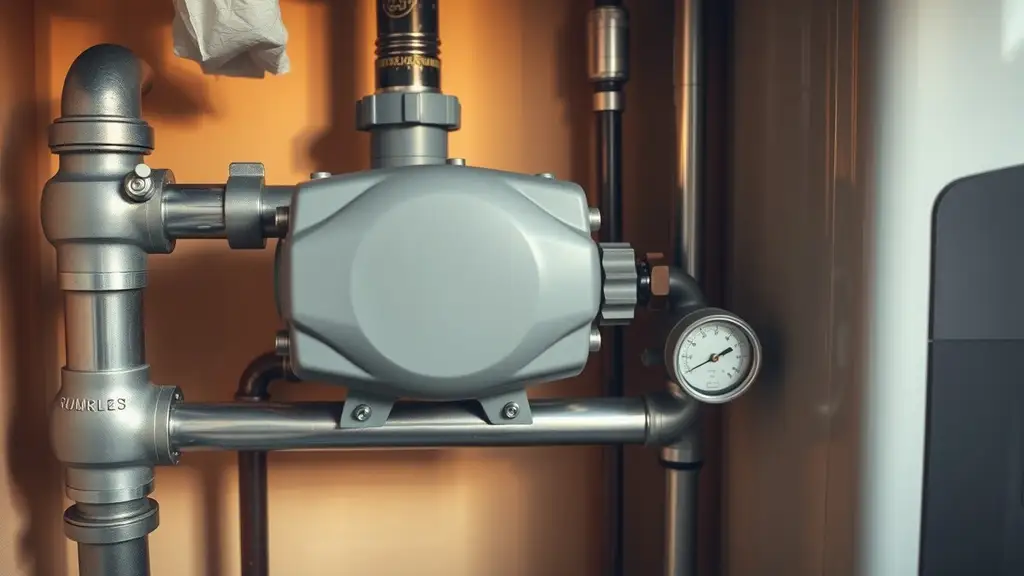
Wall-hung boilers have a built-in pump already sized for typical systems. A separate pump appears with solid-fuel boilers, multi-circuit systems or underfloor heating with its own manifold.
- Whistling or rushing noise in radiators and valves: flow too high.
- Furthest radiators lukewarm, others hot: unbalanced system or pump too weak.
- Very large flow–return difference (over about 25°C on gas): too little flow.
- Pump hums but water does not move: air in the pump or a seized rotor after summer.
Frequently asked questions
Which speed setting should I use?
The lowest setting at which all radiators heat up in reasonable time. Too high causes flow noise and higher electricity use; too low leaves the far radiators lukewarm. On modern pumps, proportional-pressure mode is usually the right choice with thermostatic valves.
Does a two-storey house need a stronger pump?
Not automatically. In a closed heating circuit the height cancels out; what counts is the resistance of the longest pipe run, the fittings and the boiler.