
Updated · 5 min read
In short
- Sliding doors need no opening space; hinged doors need 60–70 cm clear but give full access.
- A walk-in wardrobe makes sense from about 4–5 m²; below that, a floor-to-ceiling built-in is more efficient.
- Combine rails, shelves and drawers; a double rail doubles hanging space for shirts and jackets.
Sliding or hinged doors
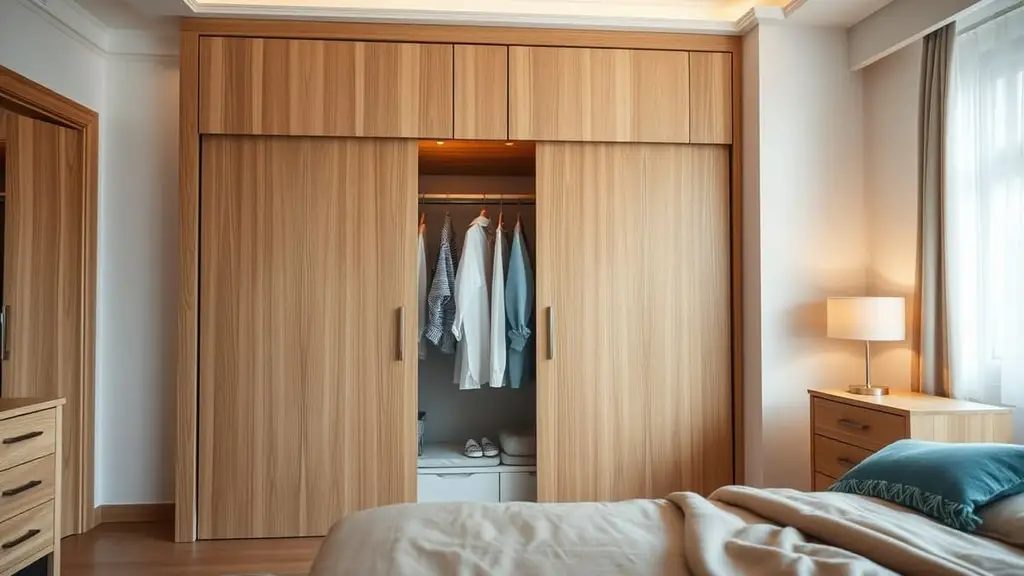
Wardrobes with sliding doors need no free opening space in front — the door slides on a track instead of swinging into the room — which makes them the natural choice for small bedrooms or wardrobes next to the bed, where a hinged door would hit the mattress or bedside table. On the other hand, access is partial: at any moment you see only half of the wardrobe, the other half hidden behind the slid door.
Hinged doors give full access to the whole interior at once and usually a simpler, cheaper mechanism to maintain — a hinge is easy to replace, while a faulty track or worn rollers may need a joiner. But they need a clear space of at least 60–70 cm in front of the wardrobe to open fully, which a tight room doesn't always have.
A sliding-door wardrobe usually costs more than an equivalent hinged one because of the mechanism (tracks, rollers, soft-close dampers). In the long run a poor-quality sliding mechanism can go out of line or get noisy, especially with heavy doors (glass or mirror) — check the maximum door weight the track takes and whether there's a soft-close damper.
Walk-in or built-in wardrobe: how much space you need
A walk-in wardrobe (a room or area dedicated only to storing clothes) makes sense from about 4–5 m² upwards devoted to that function alone, either as a separate room or a defined area of the bedroom with shelving on two or three sides. Its real advantage is visual organisation — clothes, shoes and accessories become visible and accessible without visually occupying the bedroom itself, which stays dedicated to sleep and rest.
Below that threshold, a built-in wardrobe (wall to wall or in a recess) is more efficient: it uses the full height to the ceiling and leaves no dead space above or at the sides, as often happens with a ready-made freestanding wardrobe. A made-to-measure wardrobe designed for the exact recess uses every centimetre — including corners or irregular spaces created by a beam or a radiator.
Interior organisation: drawers, shelves and rails
A well-planned wardrobe interior combines all three types of space: hanging rails (for clothes that crease — shirts, jackets, dresses), shelves (for jumpers, bed linen, seasonal covers) and drawers (for underwear, socks and small accessories that would get lost on an open shelf). A common mistake is designing only a rail and shelves with no drawers — small items end up piled on shelves and become hard to find.
Rail height matters: long items (dresses, coats) need at least 140–150 cm clear below the rail; shirts and jackets need half that, which allows a double (stacked) rail and practically doubles hanging capacity on the same width. Internal drawers on telescopic runners (not just a simple wooden groove) open more easily and carry more weight without sticking over time.
The space under the bed, an often ignored resource
In small bedrooms the space under the bed is often the only untapped storage left. Low boxes or drawers designed for that space can take seasonal bedding, spare blankets or suitcases — things used rarely that don't need daily access. A bed frame with built-in drawers solves the problem from the start, with no separate boxes to get dusty or shift around.
For a bed without drawers, lidded storage boxes low enough to fit under the base (check the clearance before buying — it varies from a few centimetres to over 25 cm depending on the frame) are a cheap, flexible solution. Avoid turning the space under the bed into a dumping ground for anything that doesn't fit elsewhere — airflow under the bed matters for sleep hygiene, especially with dust allergies.