
Updated · 5 min read
In short
- The smaller or darker the room, the lighter the dominant wall colour.
- North-facing rooms suit warm colours; south- and west-facing rooms take cool or neutral ones.
- Combine three layers of light — ambient, task, accent — with 2700–3000 K in the relaxing area.
How colours change the perception of space
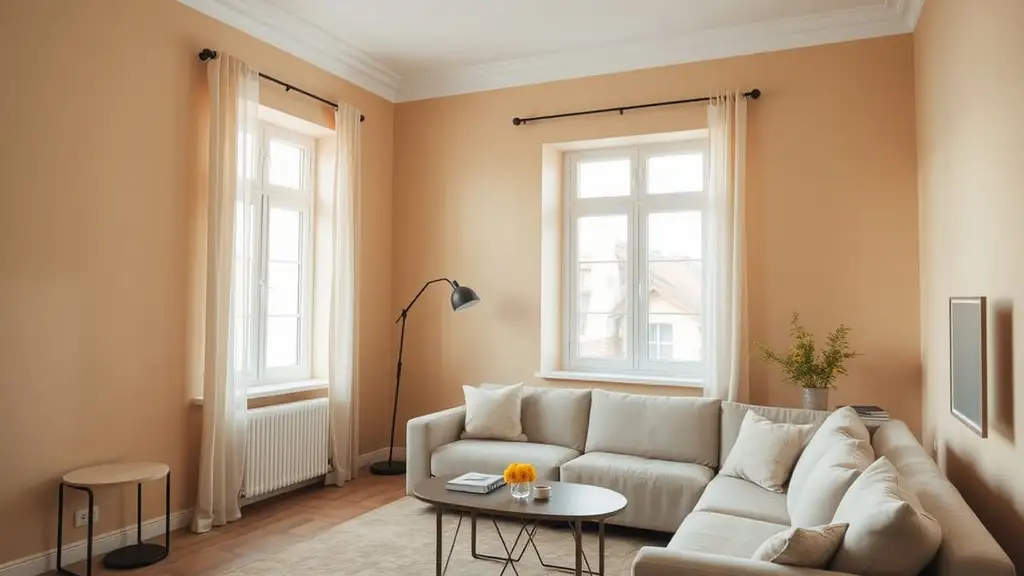
Light colours (white, beige, light grey, pastels) reflect more light and make a room feel larger — a safe choice for small living rooms or low ceilings. Dark colours (anthracite, deep green, navy) absorb light and visually 'close in' the room, but feel warm and elegant if the space is generous and well lit. The practical rule: the smaller the room or the less sun it gets, the lighter the dominant wall colour should be.
You don't have to choose between all white and all colour. A balanced option is an accent wall in a stronger colour (usually behind the sofa or the TV), with the rest in neutral tones. The risk of an intense colour on every wall is that it's hard to change later and tiring to look at over time; a rug, cushions or pictures bring the same personality and can be swapped any time without repainting.
The room's orientation changes the colour choice
A north-facing living room gets cool, constant daylight without direct sun — warm colours (beige, cream, terracotta tones, dusty pink) compensate for that coolness and make the space more welcoming. A south- or west-facing room gets warm, strong light for much of the day, so it handles cool or neutral colours (grey, pale blue, sage green) better without looking tired or heavy.
Always test the colour on the wall before painting the whole room: the same shade looks noticeably different in the morning, at midday and in the evening under artificial light. A common mistake is choosing straight from the paint chart or a screen, without seeing how it behaves in the real room with its orientation and windows.
Layered lighting, not a single source
The most common mistake in a living room is one central ceiling light, which casts hard shadows and leaves the corners dark. A well-lit living room combines three layers: ambient light (ceiling light, spots, LED strips — for general lighting), task light (a reading lamp by the armchair, a desk lamp if you work there — for activities that need concentration) and accent light (spots on a picture, an LED strip behind the TV or under a shelf — for atmosphere and depth).
Ideally each layer has its own switch or dimmer so you can adapt the mood — bright light for cleaning or guests, soft light for relaxed evenings in front of the TV. Colour temperature matters as much as brightness: light that is too cool (over 4000 K) can make a living room feel clinical; for the relaxing area, 2700–3000 K (warm white) is almost always right.
Common mistakes to avoid
A single ceiling light in the exact centre of the room, with no other source, leaves the sofa area and the corners poorly lit in the evening. Likewise, spots aimed straight at the TV viewing area cause annoying reflections on the screen. A simple, cheap fix: a floor lamp in the corner opposite the main window balances daylight with evening artificial light and removes hard shadows from the corners.
Planning the light points — how many circuits, where the switches go, whether you want dimmers — is ideally done before the walls are finished, not after. A lighting calculator helps you estimate quickly how many light sources suit your floor area.
Calculators for this job
Room lighting calculator
The lumens a room needs and how many bulbs or spots, from the area and the room type.
Paint calculator
How much wall paint you need for a room, based on the number of coats and the coverage printed on the tin.
Rug size calculator
What size rug fits a room, leaving a visible border of floor around it.