
Updated · 4 min read
In short
- Start from zones, not plants: entrance and parking, paths, terrace, garden, utility area.
- Order of works: plan → buried services (drainage, cables, irrigation) → paths and terrace → large plants → lawn.
- Paths go where people actually walk; otherwise the lawn wears along the shortcut.
1. Draw the plan
Draw to scale (for example 1 cm = 1 m) and mark:
- the house, its doors and the windows you look out of;
- orientation: where the sun is in the morning, at midday and in the evening;
- slopes and the spots where water stands after rain;
- existing services: water, drains, septic tank, cables, gas;
- trees and structures that stay, and views you want to screen.
2. The zones
- Entrance and parking: a hard surface with a drainage fall, about 3 m wide per car; lighting at the gate and door.
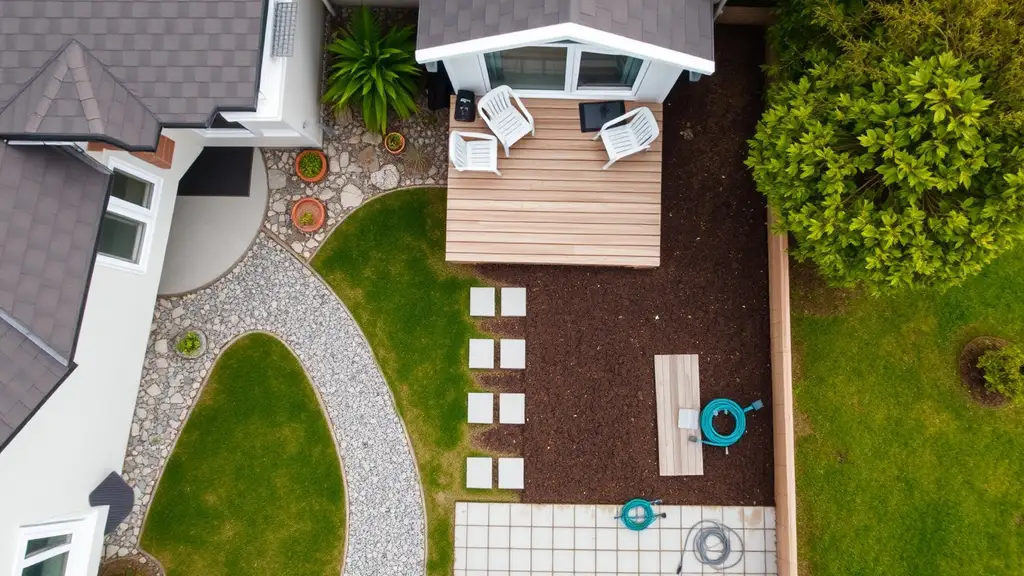
- Paths: on the routes you really use (gate–door, door–terrace, door–shed). People cut corners — a path that detours needlessly gets a worn track beside it.
- Terrace: next to the kitchen or living room, facing the evening sun or with planned shade (pergola, tree). A table for six with chairs needs about 3.5 × 3.5 m.
- Garden: lawn for play, flower or vegetable beds in full sun, trees at the legal distance from the boundary.
- Utility area: compost, shed, washing line, bins — close to a path, screened by a hedge or panel.
3. Order of works
- Drainage and rough levelling.
- Buried routes: cables for lighting and outdoor sockets, irrigation pipes, downpipes to drains.
- Foundations for paths, terrace, pergola and fence.
- Topsoil in the planting beds and lawn area.
- Trees, shrubs and hedges.
- Lawn last, in spring or early autumn.
4. Common mistakes
- lawn everywhere with no paths — it wears exactly along the routes;
- a terrace too small for the furniture — chairs no longer fit pulled out;
- trees planted too close to the house, the fence or over pipes and the septic tank;
- lighting added after paving — cables end up on top or paving gets broken;
- too many materials and colours, which break up a small garden.
Frequently asked questions
Paths or lawn first?
Heavy and buried work first — drainage, cables, irrigation pipes, path and terrace foundations — then topsoil, large plants and finally the lawn. A lawn laid earlier is ruined by wheelbarrows and machinery.
How do I lay out a small garden?
With few, clearly defined zones: a direct path to the door, a terrace sized for the table you actually use and vertical planting (narrow hedge, climbers, planters). Repeating the same materials makes the space feel larger.
Calculators for this job
Paving calculator
How many pavers a path, driveway or patio needs, with cutting waste included.
Grass seed calculator
How many kilograms of grass seed a lawn needs, from the area and the seed rate.
Garden lighting calculator
How many outdoor lights and how much cable a garden path needs, from its length and the light spacing.