
Updated · 5 min read
In short
- A neutral white–grey base ages well and makes later changes cheap.
- Use wood treated for damp, and only in the dry zones of the bathroom.
- Keep the expensive structure (tiles, fixtures) neutral and put trends on easily replaced items.
Why white–grey minimalism is still the safest choice
Minimalism — a limited palette of white, grey and neutrals, clean lines, as few decorative elements as possible — has been the most popular direction for bathrooms for years, for good reason. It ages well: it doesn't depend on a colour or pattern fashionable today and dated in a few years, so it doesn't force an early renovation for aesthetic reasons alone. Light grout (white or light grey) is easier to clean and refresh visually than very dark grout, which fades noticeably over time.
Practically, a neutral background makes every later change easy: you can replace a towel, a storage box or a plant and refresh the room without touching the tiling, which is the biggest and hardest-to-change cost in a bathroom. The main drawback is the risk of a space that feels too sterile without any contrast — hence the need for warm accents.
Wood accents treated for moisture
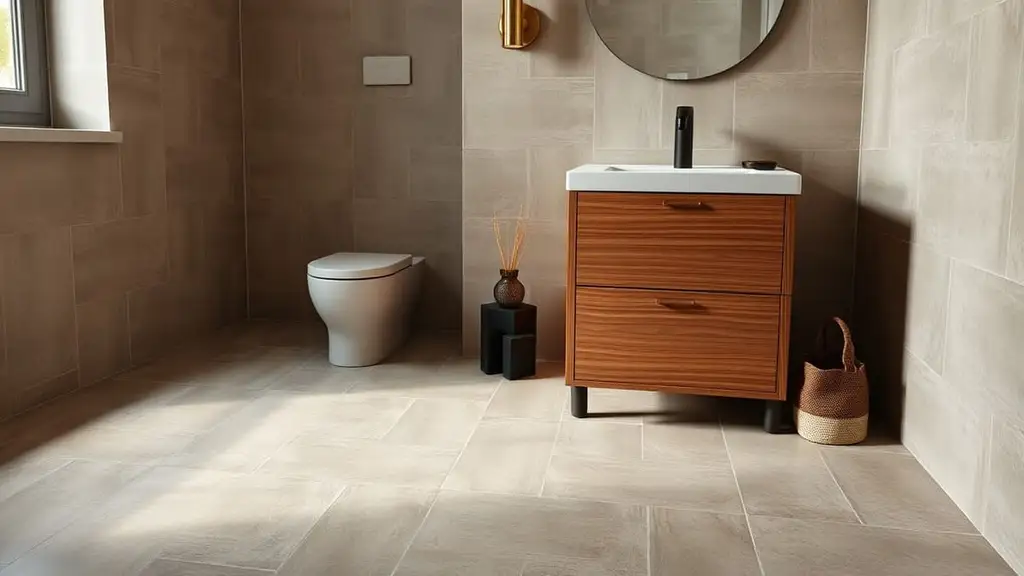
An all-white or all-grey bathroom with no organic texture can end up feeling cold and impersonal. Wood accents — a shelf, a vanity top, a stool or a storage box — add visual warmth without compromising upkeep, provided the wood is treated specifically for damp environments (thermally modified oak, wood finished with water-resistant lacquer, or moisture-resistant composite), not raw wood or furniture designed for dry rooms.
Wood that isn't properly treated absorbs moisture, swells, warps and can grow mould — a common mistake is reusing old living-room or bedroom furniture in a bathroom without checking the surface treatment. Areas in direct, constant contact with water (the edge of the bath, the shower floor) aren't suitable for wood however well treated — ceramic or stone stays there. Wood works best in the dry zones: by the basin, as a shelf or top, or as a mirror frame.
Other popular styles: industrial, natural stone, coloured grout
Industrial style — exposed concrete or concrete-effect tiles, matt black taps, metal accents — has gained ground as an alternative to pure white minimalism. It works well in bathrooms with good daylight, where dark greys don't make the space feel smaller, but it's best avoided in small windowless bathrooms, where dark surfaces emphasise how cramped the room is.
Stone-effect tiles (marble, travertine) look more 'expensive' than plain tiles, without the cost and upkeep of real natural stone, which is porous and needs periodic sealing. Coloured grout — dark grey, black or even accent colours on white tiles — is a recent trend that radically changes the character of classic tiling, but it's harder to reverse than changing an accessory, because replacing grout means partly redoing the work.
Fashion versus long-term neutrality
Bathroom tiling is usually the most expensive and hardest-to-change design decision in the whole home — unlike a sofa or a cushion, you don't replace it in a few years without significant cost and effort. So it deserves different treatment from other design decisions: structural elements (tiles, sanitaryware) benefit from neutral, stylistically durable choices, while easily changed elements (towels, bath mats, accessories, plants) are the place to experiment with colour or current trends.
If you plan to sell or let the home at some point, neutrality matters even more — a bathroom with very personal or busy styling appeals to a much narrower audience than one with a neutral base, even if it looks less spectacular in photos. A reasonable compromise: keep the structure (tiling, fixtures) neutral and leave trend accents — colour, texture, style — to the easily replaced items.
Calculators for this job
Wall tile calculator
The wall tile area for a bathroom or kitchen and the number of tiles, with openings deducted and waste included.
Floor tile calculator
How many square metres and how many tiles to order for a floor, with cutting waste included.
Grout calculator
Grout consumption per square metre and in total, from the tile size, tile thickness and joint width.